
Tanzania Safari Accommodation: What Lodges, Tented Camps & Bush Camps Really Look Like Inside

Most people have the same image in their head before their first safari: a small tent, a sleeping bag, and the distant roar of something large just outside the zip.
The reality of Tanzania safari accommodation is so far from that image — and so much better — that it genuinely surprises almost every first-time traveler.
We are talking about beds with crisp white linen under canvas ceilings, open-air showers looking out over the Serengeti plains, private plunge pools on the rim of the Ngorongoro Crater, four-course dinners served by candlelight in the middle of a national park, and waking up to the sound of elephants moving through the bush just meters from where you slept.
Tanzania's accommodation landscape spans every possible point between raw wilderness camping and some of the most extraordinary hotels on earth. This complete guide covers every type — from budget bush camping to ultra-luxury tented suites — with honest detail on what each one actually looks like, what's included, what it costs, and exactly who each option suits.

The 5 Types of Tanzania Safari Accommodation Explained
Tanzania offers diverse accommodation options that cater to every traveler's preference and budget. The main distinction lies between safari camps that emphasize wilderness immersion and resort-style lodges that prioritise luxury amenities — with options ranging from basic camping setups to luxury tented camps with premium amenities, and permanent lodge structures with full hotel-style facilities.
Here is your complete at-a-glance overview before we go deep on each one:
Type | Best For | Cost Per Night | Wilderness Feel | Comfort Level |
Safari Lodge | Families, comfort seekers | $150–$2,000+ | ⭐⭐⭐ | ⭐⭐⭐⭐⭐ |
Luxury Tented Camp | Couples, honeymooners, wildlife lovers | $300–$3,000+ | ⭐⭐⭐⭐⭐ | ⭐⭐⭐⭐ |
Budget Tented Camp | Budget travelers, backpackers | $80–$300 | ⭐⭐⭐⭐ | ⭐⭐⭐ |
Mobile/Fly Camp | Adventure seekers, photographers | $500–$2,000+ | ⭐⭐⭐⭐⭐ | ⭐⭐–⭐⭐⭐ |
Public Camping | Ultra-budget, overlanders | $30–$80 | ⭐⭐⭐⭐⭐ | ⭐⭐ |
1. Safari Lodges — The Comfort Benchmark of Tanzania Safari Accommodation
A safari lodge is a permanent structure — often built with stone, wood, or brick — offering hotel-like amenities in the wilderness. Lodges provide spacious rooms or suites with en-suite bathrooms, often with balconies overlooking savannahs or craters, blending luxury with a genuine connection to the surrounding landscape.
A safari lodge looks, from the outside, like a beautifully designed wilderness hotel. Walk through the entrance and you will typically find a reception area, a lounge filled with locally crafted furniture, a bar, a restaurant, a terrace, and a swimming pool — all facing out toward an uninterrupted view of whatever extraordinary landscape surrounds it.

What Does the Inside of a Safari Lodge Actually Look Like?
The room / suite:
Spacious — typically 40–80m² in mid-range properties, 80–200m²+ in luxury lodges
A king or twin bed with high-quality linen, mosquito net canopy, and firm supportive mattress
En-suite bathroom with flush toilet, vanity, and either a walk-in shower, bathtub, or — in luxury properties — both
Climate control — air conditioning, ceiling fan, or both depending on the property
A private balcony, terrace, or veranda with chairs and a table facing the view
USB charging points and sometimes full international plug sockets
A minibar stocked with water, soft drinks, and sometimes local snacks
In-room safe for passports, cash, and valuables
Mosquito screens on all windows and doors
The communal areas:
A main lounge with sofas, bookshelves, local artwork, and a fireplace for cool evenings
A bar serving local beers, wines, spirits, and cocktails — often with an honor system for room charges
A restaurant serving breakfast, lunch, and dinner — typically buffet or à la carte depending on the property tier
A swimming pool — often infinity-edged and positioned to face the most dramatic view in the park
A fire pit or boma for evening meals and sundowner gatherings
WiFi in the main areas (rarely in rooms — this is intentional; you are in the wilderness)
The view:This is where safari lodges truly earn their reputation. Lodges like those perched near the Ngorongoro Crater offer breathtaking panoramic views and easy access to one of Tanzania's most iconic attractions — with private terraces where guests wake up to look across the caldera or across savannah plains that stretch to the horizon without a single building in sight.
Safari Lodge Tiers: What Your Budget Gets You
Budget Lodges ($250–$350 per person per night)
Clean, functional accommodation near park boundaries. Private bathroom, mosquito nets, basic restaurant. Good wildlife access. No pool. Simple but perfectly adequate for a safari focused on game drives rather than in-room luxury.
Mid-Range Lodges ($390–$600 per person per night)
Mid-range lodges in prime Serengeti or Ngorongoro locations offer comfortable rooms with en-suite bathrooms, swimming pools, quality dining, and experienced guiding — representing excellent value for the level of experience delivered. This is the tier most independent safari travelers choose and it delivers an extraordinary experience.
Luxury Lodges ($700–$2,000+ per person per night)
Luxury lodges in Tanzania — particularly the Four Seasons Safari Lodge Serengeti — are hard to beat for the ultimate lodge experience, perched in the heart of the national park with private plunge pools, gourmet dining, a full spa, and extraordinary wildlife views from every room.
Best Safari Lodges by Location in Tanzania
Park | Recommended Tier | What to Look For |
Serengeti (Central) | Mid-range to Luxury | Rooms facing the plains; proximity to Seronera for year-round cats |
Ngorongoro Rim | Mid-range to Luxury | Crater-facing rooms; early morning descent access |
Tarangire | Budget to Mid-range | Baobab tree views; elephant-facing terraces |
Lake Manyara | Budget to Mid-range | Rift Valley escarpment views |
Ruaha | Mid-range to Luxury | Remote, river-facing, exclusive properties |
2. Luxury Tented Camps — The True Heart of Tanzania Safari Accommodation
This is the accommodation type that defines the African safari experience in the imagination of most travelers — and the reality is better than any imagination.
Imagine waking up to the distant roar of a lion, the golden African sunrise filtering through your canvas tent, and the promise of an unforgettable day exploring Tanzania's wildlife — a luxury tented safari blends the thrill of the wild with the comforts of a five-star hotel in a way that no lodge can fully replicate.
A luxury tented camp is not camping. Let's be absolutely clear about this from the start.

What Does a Luxury Safari Tent Actually Look Like Inside?
Tented camps are built from canvas on light frames — but rooms feel like suites, with proper beds, real linen, and en-suite bathrooms. At night you hear hyenas whoop and zebras bark. Staff walk you after dark.
The tent structure:
Large canvas structure on a raised wooden platform — typically 30–60m² of internal space
Stone or wooden foundation with the canvas walls rising above, creating a genuine room
Front section: a living and sitting area with chairs, a small desk, and reading lamps
Main section: a king or twin bed with hotel-quality linen, pillows, and a full mosquito net canopy
Rear section: an en-suite bathroom with flush toilet, hot shower, double vanity, and mirrors
A private veranda at the front — your personal outdoor living space with chairs and a table
Some safari tents even include a small private pool or plunge pool on the veranda, making the luxury tented experience almost indistinguishable from a lodge suite except for one crucial difference — the canvas walls that let you hear everything outside.
The canvas wall experience:This is the defining difference between a lodge and a tented camp — and for most travelers who have experienced both, it is what they choose to return to.
At night, lying in a hotel-quality bed, you hear everything the bush offers:
Lions calling across the plain — the sound traveling miles through the cool air
Elephants moving close to the tent perimeter, their footsteps surprisingly quiet, their breathing not
The rustle of smaller animals — genets, civets, bush babies — going about their nocturnal business
Total silence broken only by the wind through the canvas and the distant cry of a hyena
Tented camps put you closer to the soundtrack of the bush in a way that no lodge — however beautiful — can match. The canvas is your only separation from the wilderness, and that proximity changes how you feel about where you are.
Safety at night in a tented camp: A question every first-timer asks — and a completely understandable one.
Tented camps implement natural security through experienced guides, camp protocols, and wildlife awareness training. Staff escort guests after dark between tents and communal areas, maintaining vigilant watch throughout the night. Guests follow specific safety guidelines including staying within designated areas and using provided flashlights for nighttime movement.
In practice: a camp guard (askari) is awake and on patrol throughout the night. You will be given a torch (flashlight) and briefed on the camp's protocols at check-in. You never walk alone in the dark. This is standard practice at every reputable tented camp in Tanzania and it is handled with calm professionalism that quickly reassures even the most nervous first-timer.
The Communal Areas of a Luxury Tented Camp
Main mess tent: A large central tent serving as dining room, lounge, and bar. Long communal tables, candlelight in the evenings, and a menu that genuinely surprises most guests
Campfire/fire pit: The social heart of the camp. Stories from the day's game drives shared under a sky full of stars
Bush dinners: Many camps set up special dinners outside — a table in the open bush, candles, lanterns, and the sounds of the wild all around you
Sundowner point: A pre-selected view outside camp where your guide drives you at 5:30pm for cocktails as the sun sets over the Serengeti
3. Budget Tented Camps — Great Value, Genuine Wilderness
Budget tented accommodations in prime Serengeti locations are available from around $350 per night for a quality camp — with mobile options that move with the Great Migration, ensuring guests are always near the action without paying luxury prices.
Budget and mid-range tented camps deliver most of what luxury camps offer — the canvas walls, the sounds of the bush, the campfire evenings — at a significantly lower price point. The trade-offs are worth understanding
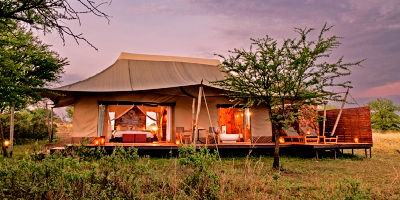
What budget tented camps have:
✅ Proper canvas safari tents on raised platforms
✅ Real beds with mattresses and linen (not sleeping bags on the floor)
✅ En-suite or shared bathroom facilities with flush toilets and hot showers
✅ A communal dining tent and fire pit
✅ An experienced guide and daily game drives
✅ The authentic sounds of the African night
What budget tented camps may not have:
❌ Private plunge pools or spa facilities
❌ Gourmet multi-course menus (expect hearty, good quality cooking rather than fine dining)
❌ Air conditioning (fans and natural ventilation only)
❌ In-tent minibar or daily laundry service
❌ WiFi in the tent (sometimes available in the main area)
For most first-time safari travelers, a well-chosen budget tented camp in a good location delivers 90% of the experience at 40% of the price of luxury alternatives. The wildlife doesn't know what you paid.
4. Mobile Camps — The Ultimate Immersion
Luxury mobile camps are just like tented camps but located in remote regions and are transferable — moving seasonally to follow the Great Migration and place guests in the heart of the action. They are positioned in close vicinity to Tanzania's national parks for the best possible wildlife access.
Mobile camps represent the frontier experience of Tanzania safari accommodation — small, intimate, exclusive, and positioned exactly where the wildlife is right now.
What makes mobile camps unique:
They move. Literally. A team dismantles and rebuilds the entire camp as the Migration moves, meaning you are always positioned at the center of the action — not waiting for wildlife to come to you
They are tiny — often just 4–8 tents — creating an extraordinarily intimate, exclusive experience
Mobile or fly camps in private conservancies offer access to remote areas of Selous, Ruaha, and the Western Serengeti where no permanent lodge exists — a level of wilderness privacy and authenticity that cannot be replicated by any permanent property.
The setting changes with each move — the Mara River in July for crossings, the southern Serengeti in February for calving, the Grumeti in June for the western crossing
What life is like in a mobile camp:
You sleep in a proper tent with a real bed, linen, and an en-suite portable bathroom
Meals are prepared by a dedicated camp chef over open fire — quality that consistently surprises guests
There is no electricity grid — solar lanterns and rechargeable battery packs provide light
No WiFi — this is feature, not a bug
At night, camp is surrounded only by the sounds of the Serengeti. No roads, no other guests, no noise
Mobile camps are the choice of experienced safari travelers, wildlife photographers, and anyone who has done a lodge safari before and wants something deeper.
5. Public Campsite Camping — Raw, Affordable, Authentic
Budget camping safaris offer the most affordable option, starting around $200 per person per day. Guests stay in designated campsites within or near national parks, sleeping in tents surrounded by wildlife sounds and starlit skies.
Public campsites exist inside Tanzania's national parks and are the most affordable way to spend nights within the park boundaries. This is proper camping — bring (or hire) your own tent, sleeping bag, and cooking equipment.

What public camping looks like:
A designated camping area within the national park, often unfenced
Basic shared toilet and washing facilities — cold water, long-drop toilets at more basic sites
No electricity — headlamps and solar lanterns are essential
A safari cook prepares meals over a gas stove or open fire
Wildlife can (and does) wander through camp — elephants, hyenas, and lions have all been recorded visiting public campsites in the Serengeti
At the basic camping end, you sleep in simple dome tents with bedrolls, meals are cooked over an open fire, and toilet facilities are basic. There is no electricity in camp — headlamps and candles provide light. The appeal is complete wilderness immersion: you are as close to the experience of early explorers as it is possible to get in modern Tanzania.
Who this suits:
Ultra-budget backpackers who prioritise wildlife over comfort
Overlanders on multi-week Africa trips
Travellers who have done it all before and want the most raw experience possible
Young adventure travelers who find the camping conditions exciting rather than challenging
Who this does NOT suit:
First-time safari travelers with no camping experience
Senior travelers or those with mobility considerations
Families with young children
Anyone who values predictable bathroom facilities after dark
What to Expect on Your First Night in Safari Accommodation
Whether you're in a lodge or a tented camp, your first night follows a rhythm that quickly becomes one of the most treasured parts of the safari experience.
The arrival: You reach your camp or lodge in the late afternoon — typically around 3–5pm. A cold welcome drink (often fresh juice, ginger tea, or a cold beer) appears immediately. Your bags are carried to your room. You are briefed on camp protocols, meal times, and the morning game drive schedule.
Sunset: Most properties arrange a sundowner — either at an on-site viewpoint, a raised deck, or driven to a spot in the park by your guide. Cold drinks, the fading light, and the sounds of the bush beginning its evening shift. This daily ritual never gets old regardless of how many nights you spend in Tanzania.
Dinner: Many of Tanzania's finest lodges have chefs who understand how to prepare meals that suit a wide range of dietary needs — and dinner is typically a genuinely impressive, multi-course affair served in the dining room, on the terrace, or in a traditional boma fire circle. Dining at a safari camp is an event rather than just a meal. Candles, lanterns, the fire, the stars, and the sounds of the wild surround you. Conversations at safari dinner tables are reliably extraordinary — every person at that table has a story from the day that they are burning to share.
The night: At night in a tented camp you hear hyenas whoop and zebras bark. Staff walk you to your tent after dinner with a flashlight — a brief, perfectly managed safety escort that quickly becomes part of the adventure rather than a concern. Most guests report the same experience: the first night, the sounds of the bush through the canvas are startling. The second night, they are comforting. By the third, they are the thing you will miss most when you get home.
The morning: Your wakeup call comes at 5:30–6:00am. Tea or coffee is brought to your tent or waiting in the dining area. The morning game drive begins in the last minutes of darkness, rolling out of camp just as the sky begins to lighten. This is the moment every day in Tanzania earns its reputation.
Amenities Guide: What Is and Isn't Available at Safari Accommodation
A question almost every traveler has — and one that catches people off guard if they don't ask in advance:
Amenity | Budget Camp | Mid-Range Lodge/Camp | Luxury Lodge/Camp |
🚿 Hot shower | Usually ✅ | ✅ | ✅ |
🚽 Flush toilet | Usually ✅ | ✅ | ✅ |
🔌 Charging points | Limited ⚡ | ✅ (limited hours) | ✅ |
📶 WiFi | ❌ or weak | Main area only | Main area / in-room |
❄️ Air conditioning | ❌ | Some properties ✅ | ✅ |
🏊 Swimming pool | ❌ | Some ✅ | ✅ |
🧖 Spa / wellness | ❌ | ❌ | ✅ |
🍷 In-room minibar | ❌ | Some ✅ | ✅ |
🧺 Laundry service | ❌ | ✅ (24–48hr) | ✅ (same day) |
🔐 In-room safe | ❌ | ✅ | ✅ |
🌙 Night game drive | ❌ (park rules) | Private concession only | Private concession ✅ |
Important note on WiFi: Connectivity in Tanzania's national parks is limited. Consider this a feature. The best safari experiences happen when phones are put away. Most properties have a satellite WiFi connection in the main lounge for essential use — messaging family to say you arrived safely, checking emails. Do not expect to stream or video call from your tent.
Choosing the Right Accommodation for Your Safari: Decision Guide
The difference between a lodge and a camp safari lies primarily in the type of accommodation, the level of luxury, and the connection to the wilderness — both can be comfortable, safe, and unforgettable, but the feeling of each one is fundamentally different.
Use this guide to choose with confidence:
Choose a Safari Lodge if you:
✅ Are traveling with young children who need predictable, secure sleeping conditions
✅ Are a first-time safari traveler who wants maximum comfort as your baseline
✅ Have mobility considerations requiring step-free access and solid flooring
✅ Value a swimming pool after midday game drives
✅ Prefer a building with solid walls around you at night
✅ Want hotel-level room service, spa, and daily housekeeping
Choose a Luxury Tented Camp if you:
✅ Are a couple, honeymooner, or traveling without young children
✅ Want the deepest possible immersion in the sounds and feeling of the African bush
✅ Are a wildlife photographer who wants to be inside the park, not commuting to it
✅ Have done a lodge safari before and want something more authentic
✅ Want the most romantic possible safari experience
✅ Are comfortable with canvas walls and the associated nighttime sounds
Choose a Mobile Camp if you:
✅ Are an experienced safari traveler wanting the ultimate frontier experience
✅ Are following the Great Migration and want to be positioned exactly with it
✅ Want exclusivity — fewer than 8 other guests in your entire camp
✅ Are a serious wildlife photographer
Choose Budget Camping if you:
✅ Are maximizing time in the parks on a limited budget
✅ Are a seasoned camper comfortable with basic facilities
✅ Value wildlife proximity over accommodation quality without compromise
If you are genuinely unsure between a tented camp and a lodge — and many first-time safari-goers are — starting with a luxury tented camp is the recommended choice. The worst that happens is you sleep less well for a night or two and gain a story you will tell for the rest of your life. The best that happens is that you discover a form of travel that lodge-based trips simply cannot replicate.
The Best Safari Accommodation by Park: Quick Reference
Park | Best Accommodation Type | Why |
Serengeti (Central) | Luxury tented camp or mid-range lodge | Inside the park; wake up already in the action |
Serengeti (Northern) | Mobile tented camp | Follow the Migration; Mara River proximity |
Serengeti (Southern/Ndutu) | Mobile or budget camp | Calving season; best value positions |
Ngorongoro Crater Rim | Rim lodge with crater views | Early morning crater descent; acclimatization |
Tarangire | Mid-range lodge or tented camp | Baobab views; excellent elephant positioning |
Lake Manyara | Budget to mid-range lodge | Good value; Rift Valley escarpment access |
Ruaha | Remote tented camp or luxury lodge | Exclusivity; walking safari access |
Nyerere (Selous) | Riverside tented camp | Boat safari access; ultimate remoteness |
Packing for Safari Accommodation: What You Actually Need
Knowing what to pack for your specific accommodation type saves significant stress:
For all accommodation types:
Headlamp or torch — essential for navigating between tent and bathroom at night
Portable power bank — solar power is limited; charge your devices during game drives
Insect repellent — DEET-based, especially for dawn and dusk use
SPF 50 sunscreen — the equatorial sun is significantly more intense than at home
Closed-toe shoes — for evening walking around camp
Malaria prophylaxis — prescribed before travel; non-negotiable
Additional for tented camps:
Warm layer — canvas tents can be cold before dawn; a fleece or light down jacket is essential June–August
Soft bag only — hard-sided luggage cannot be accommodated in small tents and cannot go on light aircraft (15kg limit including carry-on)
For budget camping:
A very good headlamp — you will use it every night
Confirm bedding provision — some budget camps provide mattresses only; bring a sleeping bag liner
Extended first aid kit — more remote locations mean fewer supplies available on-site
Frequently Asked Questions: Tanzania Safari Accommodation
What is accommodation like on a Tanzania safari?
Tanzania safari accommodation ranges from basic camping setups to luxury tented camps with premium amenities and permanent lodges with full hotel-style facilities. At the mid-range and luxury levels, guests can expect proper beds with quality linen, en-suite bathrooms with hot showers, flush toilets, comfortable lounge and dining areas, and in many cases swimming pools — all set inside or directly adjacent to Tanzania's national parks.
Are safari tents safe from animals at night?
Yes. Safari camps implement natural security through experienced guides, camp protocols, and wildlife awareness training — staff escort guests after dark and maintain a vigilant watch throughout the night. A dedicated camp guard (askari) is on patrol at all times. The canvas is more substantial than it looks, and animals in established camp areas are generally accustomed to the human presence and do not view the tents as a threat or food source. Millions of guests have slept in Tanzania's tented camps without incident.
Do safari lodges and camps have WiFi?
Most mid-range and luxury properties have satellite WiFi in the main communal areas. Coverage is limited by remoteness and weather. Do not expect reliable streaming or video calling. Tents and lodge rooms rarely have in-room WiFi. This is by design — and most guests are grateful for the digital detox once they arrive.
How cold does it get in a safari tent at night?
This depends on the season and park. June through August nights in the Serengeti and on the Ngorongoro rim can drop to 10–15°C (50–59°F). A proper warm layer and an extra blanket (always provided by the camp) are essential. January through March nights are warmer — 18–22°C — and very comfortable in canvas.
Can I charge my phone and camera at a safari camp?
Yes — but with limitations. Most camps use solar power, meaning charging is typically available during daylight hours and in the dining/lounge area. Some rooms have charging points; many do not. A portable power bank with sufficient capacity for 7 days is the single most important piece of technology to bring on a Tanzania safari.
Is accommodation included in a Gnade Safaris package?
Yes. All Gnade Safaris packages include accommodation — with the specific property selected based on your budget tier, travel dates, group composition, and priorities. We will discuss accommodation choices with you in detail before finalising your itinerary, and we can always explain exactly why we recommend a specific lodge or camp for your particular trip.
Ready to Choose Your Safari Accommodation?
Tanzania's accommodation landscape is one of the most extraordinary in the world — and the right choice transforms your entire safari experience. A tented camp inside the Serengeti, where you fall asleep to lions calling across the plain and wake before dawn to elephants at the waterhole, is simply not replicable anywhere else on earth.
At Gnade Safaris, every accommodation we recommend has been personally evaluated. We know which lodges have the best crater views, which tented camps sit closest to the Migration route, which properties are ideal for families, which ones are perfect for honeymooners, and which budget camps deliver genuinely impressive value.
We don't sell accommodation — we match you with exactly the right place for your particular trip.
👉 View Our Tanzania Safari Packages and Accommodation Options
📩 Email: gnadesafaris@gmail.com
🌐 Website: www.gnadesafaris.com
📲 WhatsApp: +255 793 832 959
Gnade Safaris — Tanzania-Based Safari Specialists. Tailor-Made Experiences. Expert Local Guides. Over 10 Years of Excellence.


Comments