
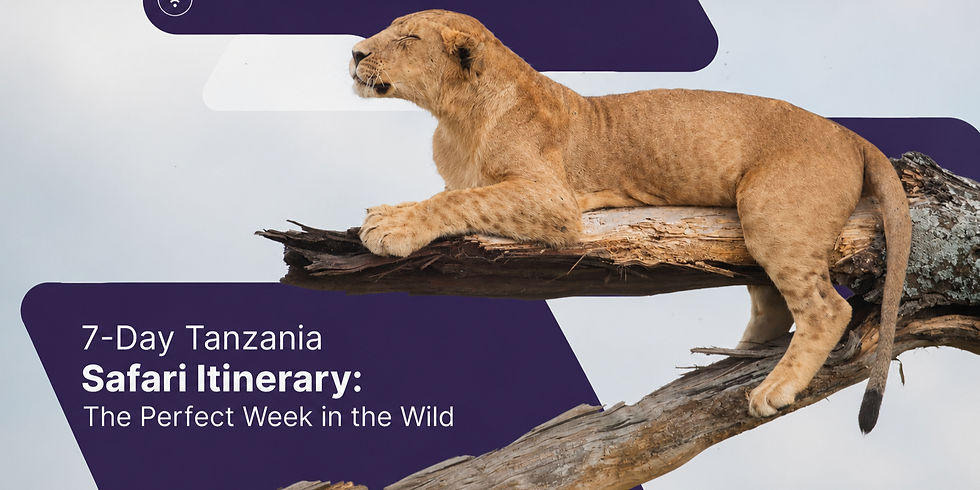
7-Day Tanzania Safari Itinerary: The Perfect Week in the Wild

Are you dreaming of watching a lion stalk across the golden Serengeti plains at sunrise? Or sitting in silence on the floor of the Ngorongoro Crater as a black rhino grazes fifty meters from your vehicle?
Seven days is the perfect amount of time to experience the very best of Tanzania's northern safari circuit — and come home having seen the Big Five, witnessed one of nature's greatest spectacles, and understood why Tanzania is consistently ranked as the world's number one safari destination.
This complete 7-day Tanzania safari itinerary covers four of Tanzania's most iconic wildlife destinations: Tarangire National Park, Lake Manyara National Park, Serengeti National Park, and the Ngorongoro Crater. It's designed for first-time safari travelers, returning wildlife lovers, couples, families, and honeymooners alike.
Ready to make it happen? Book the Gnade Safaris 7-Day Big Five Safari here →
Why 7-Day Tanzania Safari Itinerary Is the Perfect Length for a Tanzania Safari
Seven days gives you enough time to cover Tanzania's most iconic northern circuit, including the vast Serengeti and the spectacular Ngorongoro Crater, with room to add a night or two in Tarangire or Lake Manyara National Park for a truly complete experience.
Shorter trips rush you between parks. Longer trips give you more depth. But seven days hits the sweet spot — enough time to feel completely immersed in the wilderness, see extraordinary wildlife encounters, and return home genuinely transformed.
Here's what makes a 7-day Tanzania safari so special:
✅ Big Five in one trip — lion, leopard, elephant, buffalo, and rhino
✅ Four national parks — each with a completely different landscape and wildlife character
✅ The Great Migration — depending on the season, you could witness one of nature's greatest events
✅ Zero rushing — time to watch, wait, and truly experience each animal encounter
✅ Expert guiding — a full week with your dedicated driver-guide builds a genuine connection
Your 7-Day Tanzania Safari: Overview Snapshot
Day | Location | Highlights |
Day 1 | Arusha → Tarangire NP | Elephant herds, baobab trees, first game drive |
Day 2 | Tarangire NP | Full day safari, lions, leopard, diverse birdlife |
Day 3 | Lake Manyara NP | Tree-climbing lions, flamingos, hippo pools |
Day 4 | Serengeti NP (Central) | First Serengeti game drives, big cats, kopjes |
Day 5 | Serengeti NP (Full Day) | Dawn game drive, cheetah, Great Migration herds |
Day 6 | Ngorongoro Crater | Full crater floor — black rhino, Big Five |
Day 7 | Ngorongoro → Arusha | Sunrise drive, farewell breakfast, departure |
Day 1: Arusha to Tarangire National Park — Elephant Country
Drive time: ~2 hours from Arusha | Meals: Lunch & Dinner included
Your Tanzania safari begins in Arusha — Tanzania's safari capital and the gateway to the northern circuit. After your morning briefing with your Gnade Safaris driver-guide, you'll load into your custom 4×4 safari vehicle with a pop-up roof and head southwest toward Tarangire National Park.
Tarangire is one of Tanzania's most underrated gems — and the perfect opening act for your week in the wild.
As you enter the park, the landscape shifts dramatically. Ancient baobab trees — some over a thousand years old — tower over dry savannah grassland. The Tarangire River, the park's lifeline, draws enormous concentrations of wildlife during the dry season, and elephant herds of 100 or more are a common sight.
What to expect on Day 1:
Massive elephant herds — Tarangire has one of Africa's highest elephant densities
Lions and leopards resting in the shade of giant fig trees
Large herds of zebra, wildebeest, impala, and giraffe
Over 550 bird species — a paradise for birdwatchers
Spectacular sunset over the Tarangire River valley from your camp
Where you'll stay: A comfortable lodge or tented camp near Tarangire, chosen to match your style and budget. After a welcome dinner under an open African sky, you'll fall asleep to the sound of the bush around you.
This is the moment it becomes real.
Day 2: Full Day in Tarangire — Going Deeper Into the Wild
Full day game drives | Meals: Breakfast, Lunch & Dinner included
Today you have an entire day to explore Tarangire at a leisurely pace. No driving between parks, no transfers — just you, your guide, and the park's extraordinary wildlife.
Your guide will plan the morning drive around the freshest sightings and animal movements from the previous evening. Dawn is the most active time in the park — predators return from their nocturnal hunts, and the golden light transforms the baobab-dotted landscape into something truly magical.
Day 2 highlights:
Giraffe feeding at the tops of acacia trees at sunrise
Patience pays off — this is your best chance to find leopard draped over a tree branch
Cape buffalo herds moving through the dry riverbed
Greater kudu and oryx — rare, elegant antelope that thrive in Tarangire
Bush picnic lunch in a secluded spot inside the park
An evening game drive as the heat fades and the predators stir
This full day allows your guide to take you into the less-visited southern sections of the park — away from any crowds, deep in terrain where extraordinary encounters are almost guaranteed.
Day 3: Lake Manyara National Park — The Jewel of the Rift Valley
Drive time: ~1.5 hours from Tarangire | Meals: Breakfast, Lunch & Dinner included
This morning you leave Tarangire and head to Lake Manyara National Park — one of Tanzania's most diverse and visually stunning ecosystems, set dramatically along the base of the Great Rift Valley escarpment.
Lake Manyara lies between Tarangire and the Ngorongoro Crater, right along the 400-meter-deep Great Rift Valley. The park offers a remarkable variety of landscapes — from a lake covering 75% of the park, to dense rainforest with hundreds of monkeys, to woodlands where elephants roam up close.
Manyara is small but spectacular — and it punches well above its weight in wildlife density and variety.
Day 3 wildlife highlights:
Tree-climbing lions — Lake Manyara's most famous residents, often found sprawled in the branches of acacia and fig trees (a rare behavior almost unique to this park)
Huge herds of hippos wallowing in the lake shallows
Pink flamingos — thousands of them, turning the lake edge pink during the right season
Elephants navigating the forest floor in complete silence
Olive baboons and blue monkeys in the mahogany forest canopy
Over 400 bird species recorded inside the park
After your afternoon game drive, you'll continue to your overnight accommodation near Ngorongoro — perfectly positioned for tomorrow's early ascent.
Day 4: Into the Serengeti — Your First Taste of Africa's Greatest Park
Drive time: ~4 hours to Serengeti, with game viewing en route | Meals: Breakfast, Lunch & Dinner included
Today is one you will remember for the rest of your life.
You rise before dawn, enjoy an early breakfast, and begin the journey toward the Serengeti National Park — 14,763 square kilometers of open savannah that is home to more wildlife than almost anywhere else on earth.
The drive to the Serengeti is itself an experience. You'll pass through the Ngorongoro Conservation Area, winding up through the crater highlands as the temperature drops and mist rolls through the forest. As you descend the other side, the trees thin out, the land flattens, and suddenly — the Serengeti opens up before you.
The Serengeti's main draw is undoubtedly the unforgettable Great Wildebeest Migration, but the park is also home to over four thousand lions, 225 cheetahs, a thousand leopards, 3,500 hyenas, and hundreds of wild dogs — alongside countless other species your guide will delight in helping you find.
Day 4 game drive highlights:
Central Serengeti's kopjes (rocky outcrops) — famous lion pride territory
Cheetah mothers and cubs on the open plains
Vast zebra and wildebeest herds stretching to the horizon
Martial eagles, secretary birds, and lilac-breasted rollers overhead
Sunset over the endless plains — a photograph you will treasure forever
Your camp tonight is inside the Serengeti. You'll fall asleep to lions calling in the darkness — perhaps only a few hundred meters from your tent.
Day 5: Full Day in the Serengeti — The Greatest Wildlife Show on Earth
Full day in the Serengeti | Meals: Breakfast, Lunch & Dinner included
A full, uninterrupted day in the Serengeti. No transfers. No schedules. Just pure, unfiltered wilderness.
Your guide will have been monitoring wildlife movements and communicating with other guides throughout the night. The morning game drive begins before sunrise — a thermal flask of coffee in hand, the sky turning from black to deep blue to amber as you roll across the plains.
The Great Migration — what to expect by season:
The ideal time depends on what you want to see. The dry season from late June to October offers the best wildlife viewing as animals gather near water sources and vegetation is sparse, coinciding with the Great Wildebeest Migration in the Serengeti. The short rains in November and December and long rains from March to May bring fewer tourists, lush scenery, and exceptional birdwatching and photography conditions.
Day 5 wildlife highlights by season:
July–October: River crossings — wildebeest and zebra plunging into the Mara River through crocodile-filled waters in one of nature's most heart-stopping spectacles
January–March: Calving season — over 8,000 wildebeest calves born daily on the southern Serengeti plains, with cheetah and hyena in close attendance
April–June: Lush, green Serengeti with fewer crowds and outstanding photography light
November–December: Short rains bring migrating herds south — great for predator action
Regardless of the season, a full day in the Serengeti with an expert guide almost always delivers extraordinary wildlife encounters. This is the day most guests call the greatest day of their lives.
Day 6: Ngorongoro Crater — The Eighth Wonder of the World
Full crater floor descent | Meals: Breakfast, Lunch & Dinner included
Today you descend into the Ngorongoro Crater — a place so extraordinary, so densely packed with wildlife, and so visually stunning that it genuinely deserves its reputation as one of the natural wonders of the world.
The Ngorongoro Crater is a natural wonder — a collapsed volcanic caldera with steep forested sides that descend to a lush crater floor hosting one of Africa's highest concentrations of wildlife, including all of the Big Five. The crater's varied terrain — forests, grasslands, freshwater and soda lakes — creates a breathtaking setting for wildlife viewing unlike anywhere else on earth.
The crater is approximately 20 kilometers across and 600 meters deep. Once you descend the crater wall and reach the floor, you enter a completely self-contained world where an estimated 25,000 large mammals live within the confines of this ancient caldera.
Day 6 Big Five highlights in the Ngorongoro Crater:
Black Rhino — one of the rarest and most sought-after Big Five sightings in Africa; the crater hosts around 30 individuals
Lions — the crater's lion population is genetically distinct from the Serengeti's due to the caldera walls; large coalitions of males are common
Elephants — large old bulls with spectacular tusks roam the crater floor
Cape Buffalo — enormous herds of thousands, attracting the crater's lion prides
Hippos in the soda lake at the crater's center
Thousands of pink flamingos along the lake edge
Leopard sightings on the forested crater walls
A bush picnic lunch on the crater floor — surrounded by wildlife on all sides — is a deeply moving experience that few safari travelers ever forget.
Day 7: Farewell to the Wild — Return to Arusha
Morning game drive + departure | Meals: Breakfast included
Your final morning. You wake early for one last game drive — a sunrise lap of the Ngorongoro rim road or a final look out over the crater before you begin the journey back to Arusha.
The drive back winds through the crater highlands past Maasai villages, coffee plantations, and terraced farmland — a gentle re-entry into the everyday world after a week of pure wilderness.
You'll arrive in Arusha by midday. Your guide will transfer you to Kilimanjaro International Airport (JRO) or your Arusha hotel, where you'll say your goodbyes — and almost certainly make promises to return.
Most guests describe this last hour in the vehicle with their guide as bittersweet. The people, the animals, the landscapes, the silences — Tanzania has a way of getting under your skin.
What's Included in the Gnade Safaris 7-Day Big Five Safari
Here's exactly what you get when you book with Gnade Safaris:
✅ All park entrance fees — Tarangire, Lake Manyara, Serengeti, and Ngorongoro Crater
✅ Professional licensed driver-guide — English-speaking, TANAPA certified, with years of field experience
✅ Private 4×4 safari vehicle with pop-up roof for 360° game viewing
✅ All meals during the safari — breakfast, bush lunch, and dinner every day
✅ 6 nights accommodation — lodges or tented camps depending on your chosen package tier
✅ Airport transfers — pickup from and return to Kilimanjaro or Arusha Airport
✅ Bottled water throughout the safari
✅ Gnade Safaris 24/7 support before, during, and after your trip
Best Time for a 7-Day Tanzania Safari
Every season offers something extraordinary in Tanzania. Here's a quick guide to help you choose:
Season | Months | What You'll See |
Dry Season (Peak) | June–October | Best wildlife viewing, river crossings, sparse vegetation |
Calving Season | January–March | Thousands of wildebeest calves, predator action |
Green Season | April–May | Lush scenery, fewer crowds, lower prices, great photography |
Short Rains | November–December | Migrating herds arrive south, excellent birding |
The honest answer? There is no bad time for a Tanzania safari. Every month delivers incredible wildlife encounters. The question is simply which specific experience you want most.
Essential Packing List for a 7-Day Tanzania Safari
Pack light, pack smart, and pack in neutral tones:
Clothing: Khaki, olive, and tan — avoid bright colors and white
Sun protection: Sunglasses, SPF 50 sunscreen, and a wide-brimmed hat
Binoculars: Absolutely essential — 8×42 or 10×42 recommended
Camera: A telephoto lens of 300mm+ makes a significant difference
Malaria prevention: Consult your doctor before travel; prophylactics are recommended
Insect repellent: DEET-based, especially for dawn and dusk
Footwear: Comfortable closed-toe shoes for lodge and camp use; sandals for evenings
Small daypack: For in-vehicle use during game drives
Reusable water bottle: Your guide will keep it filled
Frequently Asked Questions About 7-Day Tanzania Safaris
Is 7 days enough for a Tanzania safari?
Yes — 7 days is widely considered the ideal length for a first Tanzania safari. It gives you enough time to visit four key parks, see all of the Big Five, experience both the Serengeti and Ngorongoro Crater without feeling rushed, and genuinely immerse yourself in the wilderness.
What is the best 7-day Tanzania safari route?
The most popular and rewarding 7-day route follows Tanzania's northern circuit: Arusha → Tarangire → Lake Manyara → Serengeti → Ngorongoro Crater → Arusha. This route covers the greatest variety of ecosystems and offers the highest probability of Big Five sightings.
Can I see the Great Migration on a 7-day Tanzania safari?
Yes. The Great Migration is present somewhere in the Serengeti-Mara ecosystem year-round. The most dramatic river crossings typically occur between July and October. Calving season (January–March) offers incredible predator action on the southern Serengeti. Your guide will position you in the best location based on your travel dates.
How much does a 7-day Tanzania safari cost?
Prices vary depending on accommodation level (budget camping, mid-range lodge, or luxury tented camp), group size, and time of year. Gnade Safaris offers transparent, all-inclusive pricing tailored to your preferences.
Do I need a visa for Tanzania?
Most nationalities require a Tanzania tourist visa. As of 2025, Tanzania operates an e-visa system available online before travel at immigration.go.tz. East African nationals and citizens of some countries are exempt. Check the latest requirements for your passport well before your travel date.
What vaccinations do I need for a Tanzania safari?
Yellow fever vaccination is required if you are arriving from a yellow fever endemic country. Typhoid, hepatitis A, and malaria prophylaxis are strongly recommended. Consult a travel medicine clinic or your doctor at least 6–8 weeks before departure.
Is Tanzania safe for safari travelers?
Tanzania is one of Africa's most stable and welcoming countries for international visitors. The national parks are extremely well managed and professional safari operators follow strict safety protocols. Your Gnade Safaris guide is trained in first aid and emergency response. Millions of travelers visit Tanzania safely every year.
Why Choose Gnade Safaris for Your 7-Day Tanzania Adventure?
There are many safari operators in Tanzania. Here's what makes Gnade Safaris different:
10+ years of tailor-made safari expertise — We have spent over a decade perfecting routes, building relationships with the best lodges, and training guides who are genuinely passionate about Tanzania's wildlife.
Truly private safaris — You won't share your vehicle with strangers. Your safari is yours, designed around your interests and pace.
Expert local guides — Our driver-guides are among the most experienced in northern Tanzania. They know the parks intimately and they love what they do.
Transparent pricing — No hidden costs. What you see is what you pay, with everything included.
24/7 support — From the moment you start planning to the moment your flight departs, our team is available to help with anything you need.
Ready to Start Planning Your Perfect Week in the Wild?
A 7-day Tanzania safari is not just a holiday. It's a life experience that stays with you forever — in the way you see the world, in the stories you tell, in the photographs you return to again and again.
The Serengeti, the Ngorongoro Crater, the sound of lions calling at night, the silence of an elephant herd moving through the bush at dawn — these are things you simply cannot understand until you've been there.
Let Gnade Safaris take you there.
Gnade Safaris — Tailor-Made Tanzania Safari Experiences for Over 10 Years. Based in Arusha, Tanzania. Contact us today and let's start planning your perfect week in the wild.


Comments